Supplier Screen
Data is captured on the following tab(s) of the edit screen: Overview, Details, Tax Rates, Resources, Contacts, Attributes, Services, Rates, File Attachments, Documents, Geographic Data and User Defined Fields. Below is a list of descriptions for the fields in the sections on each tab.
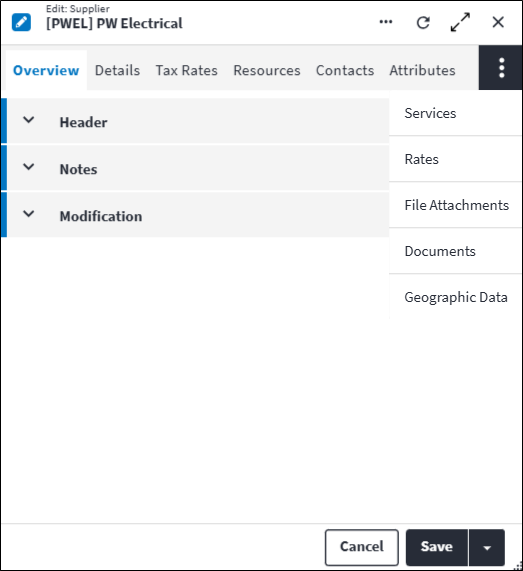
Overview
The Overview tab contains the following section(s):Header
- Code: A unique code that identifies the supplier, for example
MBP. - Description: A description of the supplier, for example
Mike Bearing Pty. - Sequence Number: The sequence in which the record should be displayed relevant to other records. Use the sequence number to list the records in a logical order.
- Is Active: Ticked if the record is active and available in lookup lists.
- Permission Tree: A field linked to a permission record in a permission tree, that determines whether a user has rights to access records and/or make changes to records. This is assigned by the system where possible.
- Site: The site to which this supplier applies. A user with access rights to this site can view and use this supplier.
- Parent Supplier: An optional parent supplier if an hierarchical parent-child structure is applicable. The parent supplier could be the head office if the supplier is a regional office; or the parent supplier could be the main contractor if the supplier is a subcontractor.
Notes
Add additional details, comments or other relevant information.Modification
Displays details of when the record was created and last updated. This section is autopopulated and requires no user input.Details
The Details tab contains the following section(s):Supplier Agreement
- Approved: Indicates whether the supplier has been approved or not.
- Material Supplier: Indicates whether the supplier is a material supplier or not.
- Contract Labour Supplier: Indicates whether the supplier is a contract labour supplier or not.
Supplier Information
- Is Virtual: Indicates whether the supplier is virtual. A virtual supplier may not have an actual supplier specified as Parent Supplier.
- Company Registration Number
- Company VAT Number
- Country of Company Registration
- Organisation Representation
- Sector: For example
RetailorFacilities Management.
Financial Information
- Company Registration Number
- Bank Name
- Bank Account Number
- Bank Branch Number
- Area
- Payment Method
- Currency: The currency the supplier trades in. Supplier Currency defaults to the Currency specified for the supplier Site.
- Tax Number: The tax number of the supplier.
- Default Tax Rate Percentage: The agreed upon tax rate percentage.
- Discount Percentage: The decimal value of the discounted percentage for this supplier.
Supplier Tax Rates
Tax rates are specified for each site that buys from the supplier.
Tax rates can be added from the Tax Rates tab on the Supplier screen or from the Supplier Tax Rates dashboard.
The grid displays the tax rates that have already been linked to the supplier. Click  in the toolbar to create a new linked tax rate.
The following information is displayed for linked tax rates:
- Buying Site Code: A site that purchases goods or services from this supplier.
- Tax Rate: The default tax percentage for this supplier.
Tax rates added from the Supplier screen are also displayed on the Supplier Tax Rates dashboard.
Refer to Supplier Tax Rates for more information.
Supplier Resources
Resources are human resources or special tools which can be applied to perform maintenance tasks on assets. Resources can be classified as staff members, special resources or contacts.
Resources are allocated trades to determine the types of jobs the resource can be used for. A resource could have multiple trades and for each trade the resource could have a different financial rate. A resource can also have multiple competencies, which are used to determine whether the resource is qualified or skilled to undertake a task.
Resources can be added from the Resources tab on the Supplier screen or from the Supplier Resources dashboard.
The grid displays the resources that have already been linked to the supplier. These resources are already preconfigured in the system and can have their own contact information. Click in the toolbar to create a new linked resource.
The following information is displayed for a linked resource and relates to the context of the resource at the supplier:
- Resource Code: A unique code that identifies the resource. This could be an HR system code, a surname, or a first name and first letter of a surname. For example
212004,KOOPMANBorTONYW. - Resource Context Code: A unique code that identifies the context of the resource.
- Resource Context Description: A short description of the resource context.
Resources added from the Supplier screen are also displayed on the Supplier Resources dashboard.
Refer to Resources for more information.
Supplier Contacts
The Contacts tab displays the contact information for a resource. It contains the following section(s):
Phone Numbers
Phone numbers are configured and grouped by phone number type, for example office number, mobile number or fax number. Multiple phone numbers can be added.
The following information is displayed when phone numbers are added:
- Phone Number Type: This identifies the type of phone number.
- Phone Number: The telephone number. The phone number can contain numbers and spaces and has to be at least four characters long.
- Sequence Number: The sequence in which the record should be displayed relevant to other records. Use the sequence number to list the records in a logical order.
- Notes: Add additional details, comments or other relevant information.
Addresses
Addresses are configured and grouped by address type, for example physical address or postal address. Multiple addresses can be added.
The following information is displayed when addresses are added:
- Address Type: This identifies the type of address.
- Body: The physical address.
- Sequence Number: The sequence in which the record should be displayed relevant to other records. Use the sequence number to list the records in a logical order.
- Notes: Add additional details, comments or other relevant information.
Emails
Email addresses are configured and grouped by email type, for example business email address or personal email address. Multiple email addresses can be added.
- Email Type: The email type.
- Email: The email address.
- Sequence Number: The sequence in which the record should be displayed relevant to other records. Use the sequence number to list the records in a logical order.
- Notes: Add additional details, comments or other relevant information.
Supplier Attributes
Attributes are used to describe the specific features, properties or characteristics of entities. An attribute is configured once and then reused across multiple entities.
A linked attribute can be inherited. When items are synced the linked attribute will be inherited, also as a linked attribute. So, if linked to an asset type, for example, then the asset will inherit the linked attribute.
Attributes can be added from the Attributes tab on the entity edit screen or from the entity Attributes dashboard.
The grid displays the attributes that have already been linked. Click in the toolbar to create a new linked attribute or click  to link an existing attribute.
The following information is displayed for linked attributes:
- Code: A unique code that identifies the attribute, for example
MODorCOL. - Description: A short description of the attribute, for example
ModelorColour. - Predefined Value: An allowed value for the attribute, which was inserted via the lookup list.
- Value: An allowed value for the attribute, which was entered via free-text.
- Predefined Value Description: A detailed explanation relating to the attribute allowed value.
Attributes added from the entity edit screen are also displayed in a consolidated list of linked attributes on the entity's Attributes dashboard.
Refer to Attributes for more information.
Supplier Services
Services are provided by external contractors to support the management, operation and maintenance of assets. Many asset services need to be performed by licensed professionals, for example electricians or plumbers.
Services can be added from the Services tab on the supplier screen or from the supplier services dashboard.
The grid displays the services that have already been linked to the supplier. Click in the toolbar to create a new linked service.
The following information is displayed for linked services:
- Code: A unique code that identifies the service.
- Description: A short description of the service.
- Qualified: Indicates whether the supplier is qualified to provide the service.
Services added from the supplier screen are also displayed on the Supplier Services dashboard.
Refer to Services for more information.
Supplier Rates
Supplier rates refer to the costs charged by an external supplier or contractor for providing goods or services related to an asset. This rate is agreed in a contract, service level agreement or purchase order and defines how much a specific service costs (per hour, per unit or per job).A supplier rate is configured for each service a contractor provides.
Supplier rates differ from service rates; the supplier rate is the actual rate charged by the supplier for providing the service, while the service rate is the generic cost provision used by the asset manager for cost allocation, recovery and benchmarking before the service is linked to a specific supplier.
Rates can be added from the Rates tab on the supplier screen or from the supplier rates dashboard.
The grid displays the rates that have already been linked to the supplier. Click in the toolbar to create a new linked rate.
The following information is displayed for linked rates:
- Code: A unique code that identifies the rate.
- Description: A short description of the rate.
- Rate: The current active rate applicable for the service provided.
- Currency Code: The currency applicable to the rate.
- Unit of Measurement Code: The unit of measurement applicable to the rate.
Rates added from the supplier screen are also displayed on the Supplier Rates dashboard.
Supplier Rate Values
The values detail tab contains a record of the rate history for each rate, including the current rate, the old rate and the future rate if applicable. This helps to visualise the rate changes that occur, when these changes take effect and how rate versions evolve.
Values can be added from the Values tab on the supplier rate screen or from the supplier rate values dashboard.
The grid displays the values that have already been linked to the supplier rate. Click in the toolbar to create a new linked value.
The following information is displayed for linked values:
- Rate Value Type: A classification of the rate value. Selectable values are:
Current: The active rate today. Upon the save action of the supplier rate record, a supplier rate value record with Rate Value Type valueCurrentis created. This is system-generated and not selectable by a user.Future: An upcoming rate that is not yet active.Historical: An expired rate that it no longer active.
- Valid From and Valid To: Define the valid date range of the value. Valid From date and time needs to be before Valid To date and time if both are specified.
- Rate: The rate applicable for the service performed.
Values added from the supplier rate screen are also displayed on the Supplier Rate Values dashboard.
Supplier File Attachments
The file attachments tab allows the user to upload and attach an object-specific file that applies only to this specific record. An example could be to attach an invoice to a work order for work completed.
The following file types can be attached to a record:
- PDF document
- Word document
- Excel spreadsheet
- Image file
- Audio file
- Video file.
Refer to File Attachments for more information.
Supplier Documents
The purpose of the document linking functionality is to link a document record that has been added to the On Key document library to one or many entities. An example of this could be an instruction manual of how to repair an asset type. This instruction manual can be created as a document record and then linked to a specific asset type. Upon syncing, the instruction manual will be inherited to the child assets, asset components and asset component placeholders when set and linked.
Information regarding linked documents, including the file location, file name, file size and file type, is displayed. For work order documents and work order task documents, Is Copied Document Link also indicates whether the document link was copied from the relevant regular asset type task or regular asset task.
Refer to Document Linking for more information.
Supplier Geographic Data
The geographic data tab displays the entity's saved geographic location. The following geographic location types are supported:
- Point: A single marker on the map.
- Line: Multiple markers on the map connected by a straight line to form a line. Also known as a polyline.
- Area: Multiple markers on the map connected by a straight line to form a polygon.
From the geographic data tab, the map can be viewed and interacted with using the following actions:
- Click: Click on the map to select a location.
- Drag panning: Click and hold down the mouse button while moving the cursor to drag the map.
- Double-click zoom: Rapidly click the left mouse button twice in succession to zoom in on a specific area of the map. If a marker that represents an entity is double-clicked, the record is opened.
- Scroll wheel zoom: Use the mouse scroll wheel (or track pad gestures) to zoom in and out of the map.
- Pinch zoom on mobile: Place two fingers on the screen and either move them apart to zoom out on the map or bring them closer together to zoom in.
- Zoom to area: Hold down the Shift key while dragging a selection box around a specific area of content. Upon release the view zooms in to focus on the selected area.
A new location can be added by selecting the relevant location type from the toolbar (point  , line
  or area
  ). Once added, the new location can be saved to the entity record.
Alternatively, the GPS latitude and longitude coordinates can be entered into the coordinates input field (for example -29.6820874442994, 23.8956069946289). Once the add action () is selected, the location is indicated on the map with a marker.
The following geographic details are available for records with saved locations:
- Reference Entity Type: The type of reference entity, for example
Regular AssetorWork Order. - Reference Entity: The specific reference entity record, for example the specific regular asset.
- Unit of Measurement: The unit of measurement that is used to indicate the location, for example
km. - Start Position: The start offset from the reference entity, for example
45. - End Position: The end offset from the reference entity, for example
50. - Length: The length of the marker in the specified Unit of Measurement, for example
5. - Notes: Add additional details, comments or other relevant information.
Supplier User Defined Fields
User defined fields are used for capturing specific information required to support a client's custom business processes. The user defined fields on an entity are preconfigured. They pull through automatically from the user defined fields that are set up on the associated database table in the master data.
Refer to User Defined Fields for more information.
Assist custom actions
The following custom actions are available in the Assist panel in the sidebar. Keep in mind that some of these custom actions are only available from the edit screen, while others are available from both the dashboard and edit screen.- Set Active / Set Inactive: Refer to Set Items to Active or Inactive.
- Change Permission Tree: Refer to Change Permission Tree.
- Change Site: Update the Site value of the selected record.
- Add to Compare: Refer to Add Items for Comparison.
- Cross References: Refer to Perform Cross Reference.
- View Changelog: Refer to View Changelog.