Requisition Screen
Data is captured on the following tab(s) of the edit screen: Overview, Items, Transactions, Attributes, Status Change History, File Attachments, Documents and Approvals. Below is a list of descriptions for the fields in the sections on each tab.
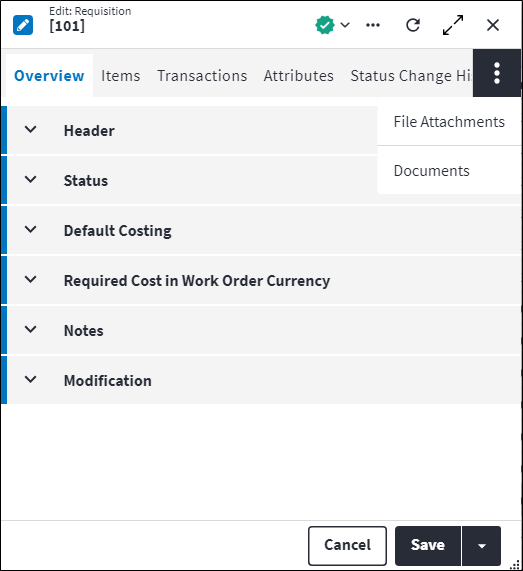
Overview
The Overview tab contains the following section(s):Header
- Work Order: The work order to which the requisition is linked. This is read-only when the requisition has items linked to it.
- Code: The system assigns a unique code to identify the requisition based on the length and prefix set in system options.
- Requester Type: Assists the user in identifying who is requesting the work to be performed.
Possible values are:User: This is the default setting and will populate the details of the person who is currently logged in.Free Text: When this item is selected the Requester Contact Code field becomes free text and the user can manually insert the name of the person who initiated the request.Contact: When this item is selected the Requester Contact Code field becomes available to select a requester.
- Requester Contact: This field is only editable if the Requester Type is set to
Contact. This requester is selected from the lookup which will contain a list of resources that have a Resource Type set toContactorStaff Member. - Requester: If the Resource Type value
Contactis selected, the field will be read-only and display the full name of the resource selected in the Resource Contact Code field.
If the Resource Type valueFree Textis selected, then the field will be editable and the name of the person who initiated the request can be populated in this field. - Requested On: The calendar date and time when the requisition was created. This defaults to the current date and time.
- Request Type: A lookup to predefined values. This field assists in the approval process.
- Importance: Indicates the importance of the requisition, which can be used to assist the planner with identifying and prioritising requisitions. This defaults to the Work Order Importance and is only editable in
Awaiting ApprovedandApprovedbase statuses. - Site: The site to which the requisition applies. This will default to the Site of the linked work order.
- Permission Tree: A field linked to a permission record in a permission tree, that determines whether a user has rights to access records and/or make changes to records. This is assigned by the system where possible.
- Sequence Number: The sequence in which the records are listed. Use the sequence number to list the records in a logical order.
Status
- Status: The current status of the requisition. Possible values are:
Awaiting ApprovalAwaiting Approval WorkflowApprovedCompletedClosedCancelled.
- Remark: This read-only field displays the latest status change remark if it was specified at the time of changing the status to the current status. Refer to Change Requisition Status for more information.
- Approval Workflow Progress:The progress relating to the approval process of this requisition and its related requisition items. Possible values are:
- Null: The Status of the requisition is not yet
Awaiting Approval Workflowor the approval workflow process has not been enabled for this site. Not Started: The Status of the requisition isAwaiting Approval Workflowand there are matched expressions, but no approvals or rejections have taken place on the requisition header record or any of the linked requisition items.Rejected: One of the required approvals on the requisition header record or the linked requisition items has been unsuccessful.In Progress: The requisition approval workflow process has started, but one or more of the required requisition approvals on the requisition header record or the linked requisition items are still outstanding.Approved: All of the required requisition approvals on the requisition header record as well as the linked requisition items have been successfully completed.
- Null: The Status of the requisition is not yet
Default Costing
- General Ledger: The General Ledger specified on the work order. This field is read-only.
- Cost Centre: The Cost Centre specified on the work order. This field is read-only.
Required Cost in Work Order Currency
- Stock Items: The total cost of all the stock items required for the requisition.
- Coded Non-Stock Items: The total cost of all the coded non-stock items required for the requisition.
- Contractor Items: The total cost of the contractors required for the requisition.
- Direct Purchase Items: The total cost of all the direct purchase (DP) items required for the requisition.
- Total Required Cost: The total value of all the items required for the requisition.
- Total Transaction Cost: The sum of all the issues and returns made for the requisition.
Notes
Add additional details, comments or other relevant information.Modification
Displays details of when the record was created and last updated. This section is autopopulated and requires no user input.For a list of validations and side effects, refer to Requisitions.
Items
The Items tab lists all the items that are required for the requisition.
The following types of items can be added:Stock item: Items that are usually in regular demand. Stock items are booked in as inventory and kept on hand in a store or warehouse.Coded non-stock item: Items that are occasionally required and only purchased when a specific work order is being planned. Coded non-stock items are not kept in stock although they are coded.Direct purchase: Items that are seldom required and do not have allocated codes in the system.Contractor: Items provided by the contractor. Contractor items include items such as equipment, materials or services.
Take note: When a requisition item is added to a requisition, a work task spare is created on the work order and some of the financial fields on the requisition item becomes read-only. These fields can only be changed on the work task spare of the work order.
Stock and non-stock items can be added to the same requisition, however this needs to be configured in system options. Refer to Requisitions Defaults Screen for more information.
Refer to Requisition Item Screen for more information.
Transactions
The table shows a consolidated view of all issues and returns done on a requisition. Each time an issue or return is done an entry is created. This table is used as the reference point to work order costing and allows API integration.
Requisition Attributes
Attributes are used to describe the specific features, properties or characteristics of entities. An attribute is configured once and then reused across multiple entities.
A linked attribute can be inherited. When items are synced the linked attribute will be inherited, also as a linked attribute. So, if linked to an asset type, for example, then the asset will inherit the linked attribute.
Attributes can be added from the Attributes tab on the entity edit screen or from the entity Attributes dashboard.
The grid displays the attributes that have already been linked. Click  in the toolbar to create a new linked attribute or click
  to link an existing attribute.
The following information is displayed for linked attributes:
- Code: A unique code that identifies the attribute, for example
MODorCOL. - Description: A short description of the attribute, for example
ModelorColour. - Predefined Value: An allowed value for the attribute, which was inserted via the lookup list.
- Value: An allowed value for the attribute, which was entered via free-text.
- Predefined Value Description: A detailed explanation relating to the attribute allowed value.
Attributes added from the entity edit screen are also displayed in a consolidated list of linked attributes on the entity's Attributes dashboard.
Refer to Attributes for more information.
Requisition Status Change History
This section shows all the statuses changes through which the requisition has gone to date.
Requisition File Attachments
The file attachments tab allows the user to upload and attach an object-specific file that applies only to this specific record. An example could be to attach an invoice to a work order for work completed.
The following file types can be attached to a record:
- PDF document
- Word document
- Excel spreadsheet
- Image file
- Audio file
- Video file.
Refer to File Attachments for more information.
Requisition Documents
The purpose of the document linking functionality is to link a document record that has been added to the On Key document library to one or many entities. An example of this could be an instruction manual of how to repair an asset type. This instruction manual can be created as a document record and then linked to a specific asset type. Upon syncing, the instruction manual will be inherited to the child assets, asset components and asset component placeholders when set and linked.
Information regarding linked documents, including the file location, file name, file size and file type, is displayed. For work order documents and work order task documents, Is Copied Document Link also indicates whether the document link was copied from the relevant regular asset type task or regular asset task.
Refer to Document Linking for more information.
Requisition Approvals
Organisations can streamline their approval processes by implementing multi-level approval workflows based on predefined values and user defined criteria. This is optional functionality that is enabled per site. Requisition approval workflows can be configured to be required on requisition header level or on requisition item level.
The Approvals tab displays the approvals assigned to all users for this record.
Refer to Approvals for more information.
Assist custom actions
The following custom actions are available in the Assist panel in the sidebar. Keep in mind that some of these custom actions are only available from the edit screen, while others are available from both the dashboard and edit screen.- Change Permission Tree: Refer to Change Permission Tree.
- Set Requisition Status: Refer to Change Requisition Status.
- Issue All: Refer to Issue or Return Requisition Items.
- Return All: Refer to Issue or Return Requisition Items.
- Add to Compare: Refer to Add Items for Comparison.
- Cross References: Refer to Perform Cross Reference.
- View Changelog: Refer to View Changelog.